


The answer to how to start an online store without inventory comes down to four core models: print on demand, dropshipping, digital products, and made-to-order. All you have to do is pick a targeted niche, connect a platform like Shopify or Etsy to a supplier app, generate product visuals with AI tools like Blend instead of organizing an expensive photoshoot, and market to one clear audience before scaling to more products.
Now, if the thought of renting storage space, ordering a thousand units of something, and hoping it all sells makes you nervous, you are not alone. That's exactly why so many people search for how to start an online store without inventory before they build anything.
You don't need a warehouse or a big pile of savings to launch a store that actually makes money. Print on demand, dropshipping, digital products, and made-to-order goods all let you sell first and produce or ship later.
If you are keen on finding out how to open an online store without inventory, we have a helpful step by step guide for you. It covers everything. From online clothing store without inventory to a shoe store without inventory, or something completely different like handmade jewelry or printable planners.
The process listed in this article applies to almost any product category. You will learn which no-inventory model fits you, how to find a niche worth building around, and how to make your products look good enough to sell before a single unit exists.
What "No Inventory" Actually Means
Selling without inventory doesn't mean selling without effort. It just means you are not the one holding boxes of stock in a garage or paying a warehouse fee every month.
With models like print on demand or dropshipping, a supplier makes or ships the product only after someone buys it. Digital products skip physical stock entirely. Made-to-order items get built once the order comes in.
What all of these share is simple: you are not paying for stock upfront, and you are not guessing what will sell before you find out. Having said that, starting an online store without inventory for free isn't quite realistic in the strictest sense.
You will still spend on your domain, your platform, and marketing. What you are really doing is pushing the biggest financial risk, unsold stock, to the very back of the line instead of the very front.
RELATED READING: How to Start an eCommerce Business in 2026: 9 Simple Steps
Why People Sell Online Without Holding Stock
A few reasons people choose this route over traditional retail:
- You don't need a big chunk of startup capital just to open the doors
- You can test five product ideas in a month instead of betting everything on one
- There's no warehouse, no shelving, no "where do I even put this"
- The whole thing can run from a laptop, from almost anywhere
- Mistakes cost you a few dollars instead of a few thousand
It's not without downsides. Margins on dropshipped or print on demand items tend to run thinner than buying in bulk, and you are relying on a supplier to get the details right. But if you are testing a first business idea, or trying something out before committing fully, it's hard to beat.
7 Steps to Start an Online Store Without Inventory
Here's everything you need to know about starting an online store without holding inventory, from choosing the right business model to building a brand customers remember.
1. Pick the No-Inventory Model That Fits You
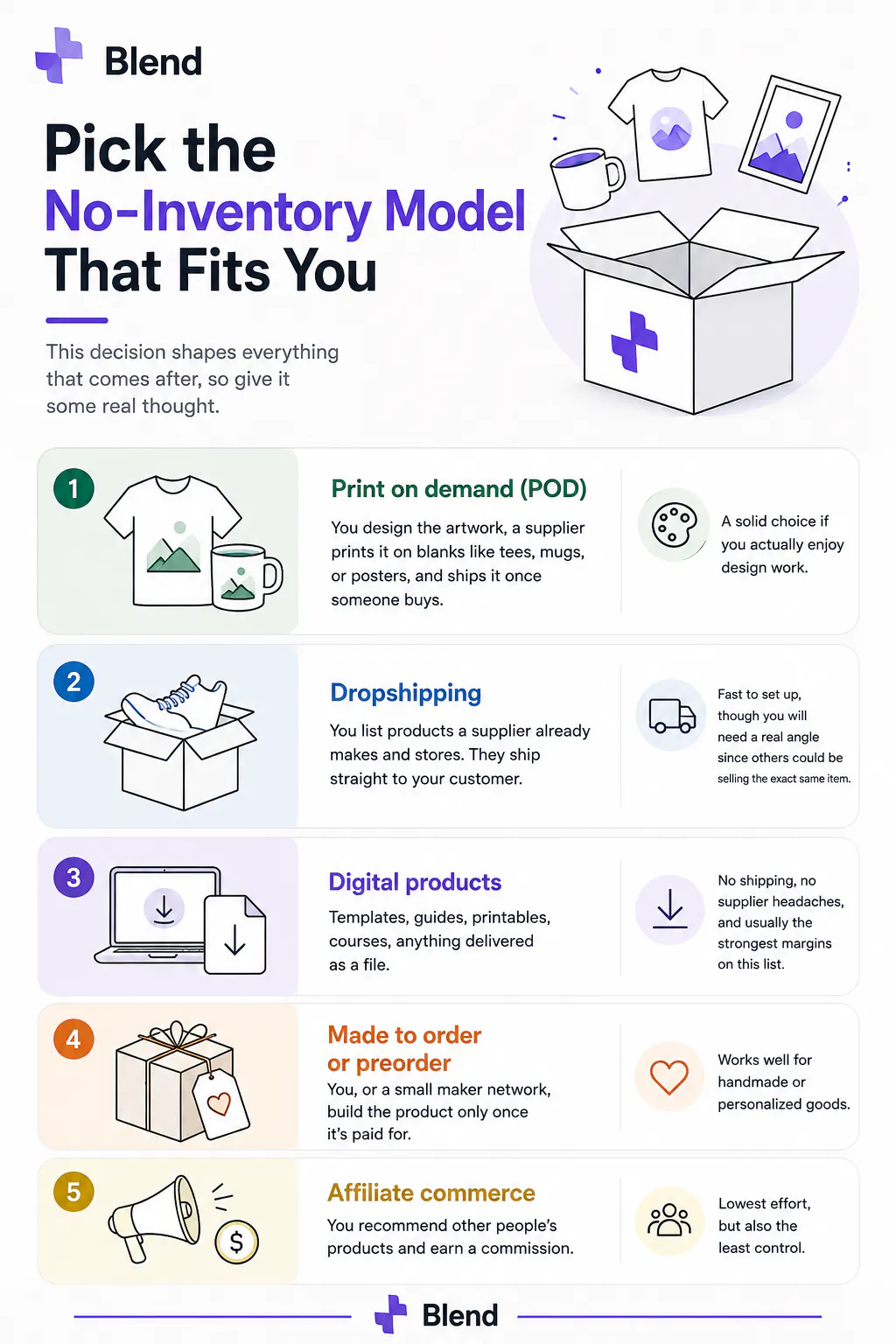
This decision shapes everything that comes after, so give it some real thought.
- Print on demand (POD): You design the artwork, a supplier prints it on blanks like tees, mugs, or posters, and ships it once someone buys. This is a solid choice if you actually enjoy design work.
- Dropshipping: You list products a supplier already makes and stores. They ship straight to your customer. Fast to set up, though you will need a real angle since others could be selling the exact same item.
- Digital products: Templates, guides, printables, courses, anything delivered as a file. No shipping, no supplier headaches, and usually the strongest margins on this list.
- Made to order or preorder: You, or a small maker network, build the product only once it's paid for. Works well for handmade or personalized goods.
- Affiliate commerce: You recommend other people's products and earn a commission. Lowest effort, but also the least control.
Selling shoes without inventory:
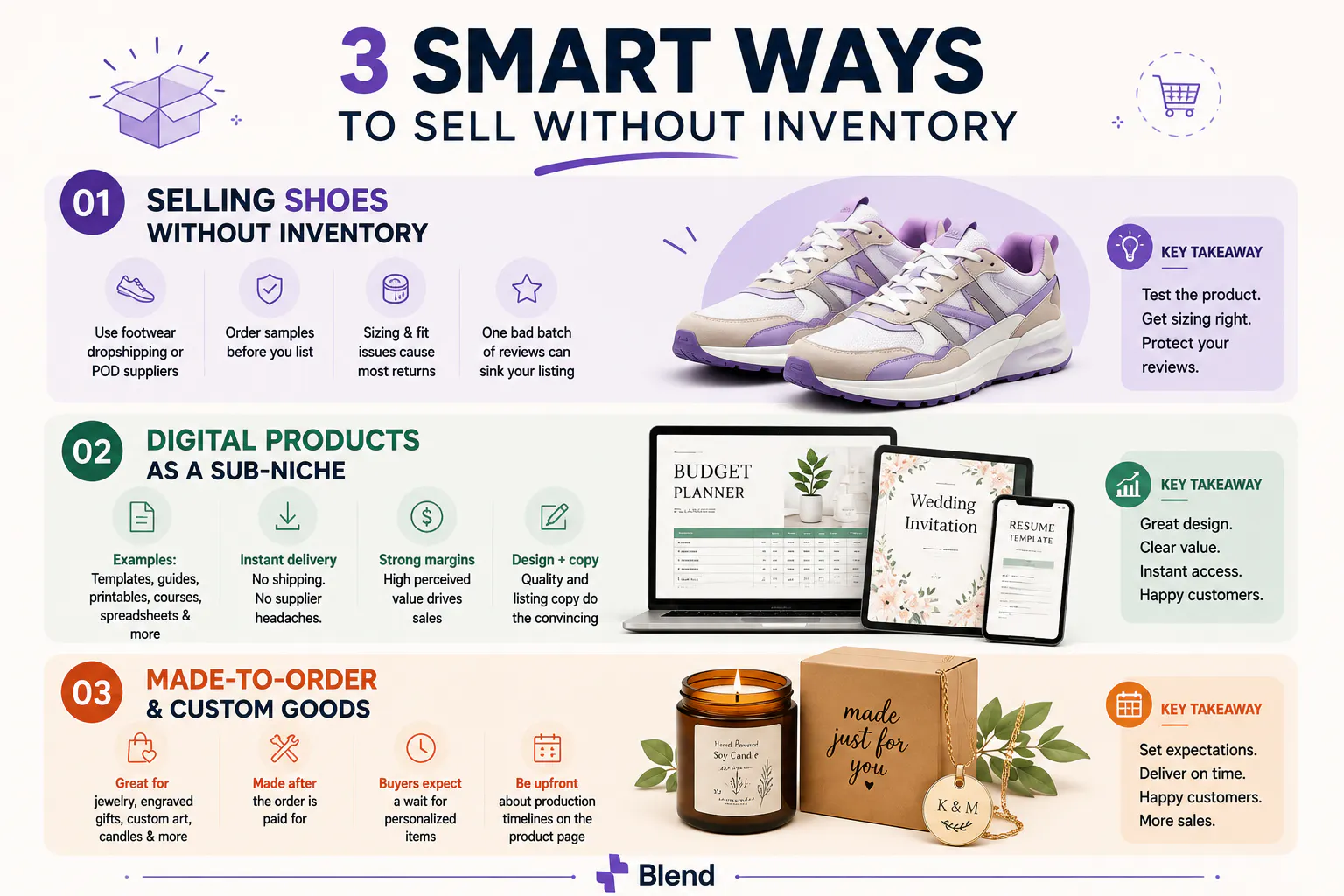
Footwear runs a little differently from apparel because sizing and fit expectations are stricter. Most sellers who search for how to sell shoes online without inventory end up using a dropshipping supplier that specializes in footwear, or a print on demand partner that offers custom sneaker printing.
Either way, order a sample pair yourself before listing anything. Sizing complaints are one of the biggest sources of returns in this category, and a single bad batch of reviews can sink a new shoe listing fast.
Digital products as a sub-niche:
If physical fulfillment sounds like more hassle than you want, digital goods are worth a closer look on their own. Printable wall art, resume templates, wedding invitation sets, budget spreadsheets, and Canva templates all sell well because the buyer gets the file instantly and you never touch a supplier.
The tradeoff is that digital products live or die on perceived value, so the design quality and the listing copy have to do all the convincing.
Made-to-order and custom goods:
This model suits jewelry, engraved gifts, custom art, and small-batch candles particularly well. Customers already expect to wait a bit for something personalized, which buys you time to actually make the item after it sells. Just be upfront about production timelines on the product page. A surprise two-week wait is where most made-to-order complaints come from.
Plenty of sellers who want to sell merchandise online without a warehouse end up running two models side by side, say print on demand for apparel alongside a small line of digital add ons. You can select whichever model is the most convenient for you and go ahead with it.
RELATED READING: Best AI Photo Editing and Video Apps for Small Businesses in 2026
2. Find a Niche People Are Already Searching For
"I want to sell candles" isn't really a niche. "Soy candles for people who miss their college dorm smell" is getting somewhere. The narrower and more specific your audience, the easier it becomes to write ads, pick designs, and rank in search, which matters a lot if you want your store to actually show up on Google.
A quick way to check demand before building anything:
- Search your idea on Google Trends and see if interest is rising, flat, or fading
- Scroll Etsy or Amazon search suggestions for related long tail terms
- Check Pinterest and TikTok for the visual style people are into right now
- Look at what competitors sell, and what their reviews complain about. That gap is often your opening
Once you have settled on a direction, build one product concept and see if people click on it before making twenty more.
3. Choose Your Platform and Fulfillment Partner
Shopify is the go to choice for most people learning how to sell online without inventory. It's easy to set up and connects to nearly every supplier app out there. WooCommerce gives you more control if you are already comfortable with WordPress.
Etsy hands you built in foot traffic, which helps a lot for handmade, personalized, or print on demand products, though it does have rules around disclosing production partners, which are worth reading through in Etsy's seller handbook before you list anything.
If you are stuck deciding between a fully owned storefront and a marketplace, it's worth reading a closer comparison of Shopify vs Etsy for print on demand before committing, since the fees, audience access, and creative control differ more than they first appear.
Whichever you choose, test the actual handoff before going live. Does the order route to your supplier automatically? Does tracking make its way back to your customer? What happens if someone wants to change their address five minutes after checkout? These small details separate a smooth running store from a support ticket nightmare.
RELATED READING: Candle and Handmade Product Photography Guide
4. Make Your Products Look Real Without a Photo Studio
This is where most people starting an online store without inventory get stuck. You don't have the product in hand to photograph. No sample, no studio, sometimes not even a real prototype yet. And a flat, generic mockup on a plain background rarely sells anything. People need to picture the item in their actual life before they'll pay for it.
This is where a tool like Blend becomes genuinely useful. Instead of booking a photographer or setting up a lightbox at home, you upload a plain product shot and Blend generates studio quality photos, realistic AI model shots, and lifestyle scenes around it.
A mug on a cozy kitchen counter, a hoodie on a model in warm afternoon light, a skincare bottle sitting on a bathroom shelf. You can also create ghost mannequin shots, swap backgrounds, and even generate short AI videos, all from one dashboard, without waiting on a shoot.
A few ways this helps if you are figuring out how to sell t shirts online without inventory, or really any product category:
- You can test a product before it physically exists. Generate a lifestyle shot, run it as an ad, and see if people respond before committing to a supplier
- Every item in your catalog gets a consistent look, which matters once you are managing more than a handful of SKUs
- Amazon and Etsy image requirements get a lot less painful, since you can generate compliant background shots in minutes
- It costs a fraction of a real photoshoot, which counts when your whole model is built around keeping upfront spending low
Whatever tool you settle on, aim for a hero shot, a lifestyle shot, a close up, and something that shows scale or fit. That's usually the minimum needed to make a product page feel trustworthy.
5. Build Product Pages That Actually Convert
Once your visuals are sorted, your page copy has to do the rest of the selling. Structure it in the order a buyer actually needs the information:
- What the product is, in plain language
- Who it's for, or when they'd reach for it
- The one thing that makes it different
- Materials, sizing, or specs
- Shipping and production timelines
- Returns or replacement policy
Skip the generic "premium, high quality" filler. "A slouchy oversized hoodie for people who run cold in every office" tells a buyer more in one line than three paragraphs of adjectives ever could. We have a complete guide on how to create the perfect product detail page design. Once you learn the art of building product pages, you are going to double your sales in no time.
6. Get Your Pricing and Margins Straight
It's tempting to just match whatever competitors charge, but that ignores your actual costs. Work backward from this:
Selling price minus product cost minus shipping minus platform fees minus payment fees minus expected returns equals what you actually keep
Here's what that looks like with real numbers. Say a print on demand t-shirt costs $13.50 to produce and $4.50 to ship. If you price it at $25, you are left with $7.00 to cover ad spend, payment processing fees, and returns, which usually isn't enough once marketing costs are factored in.
Bump the price to $29 or $30, or find a supplier with lower base costs, and that margin starts to actually support a business. A good rule of thumb for POD and dropshipping is to aim for at least a 40 to 50 percent gross margin before ad spend, since paid marketing alone can easily eat 15 to 25 percent of your revenue.
If that number looks too slim once real costs are plugged in, that's usually not a pricing problem. It's a product, supplier, or positioning problem. You need to fix it before you drop the price and hope for the best.
RELATED READING: Luxury Color Palette: 25 Elegant Colour Combinations That Make Any Brand Look Premium
7. Launch With One Product and One Clear Audience
Understand one thing clearly. Do not dump fifty products into your store on day one and hope the algorithm sorts out who to show them to. it doesn't work that way. You need to pick one product, one specific audience, and one clear reason for them to buy right now.
Use organic content, behind the scenes posts, design process clips, "which color should I launch next" polls, to warm people up before running any ads. Keep an eye on these numbers so you know what's actually working:
- Click through rate on your ads or posts
- Add to cart rate on the product page
- Checkout completion
- Return or refund rate
If clicks are strong but nobody's adding to cart, your product photos or pricing are probably the issue, which loops right back to step 4.
Conclusion
Starting an online store without inventory really comes down to flipping the usual order of operations. You prove people want it before spending real money making it. Pick your model, narrow your niche, get your visuals looking sharp, and write a product page that tells a clear story. The rest tends to follow.