
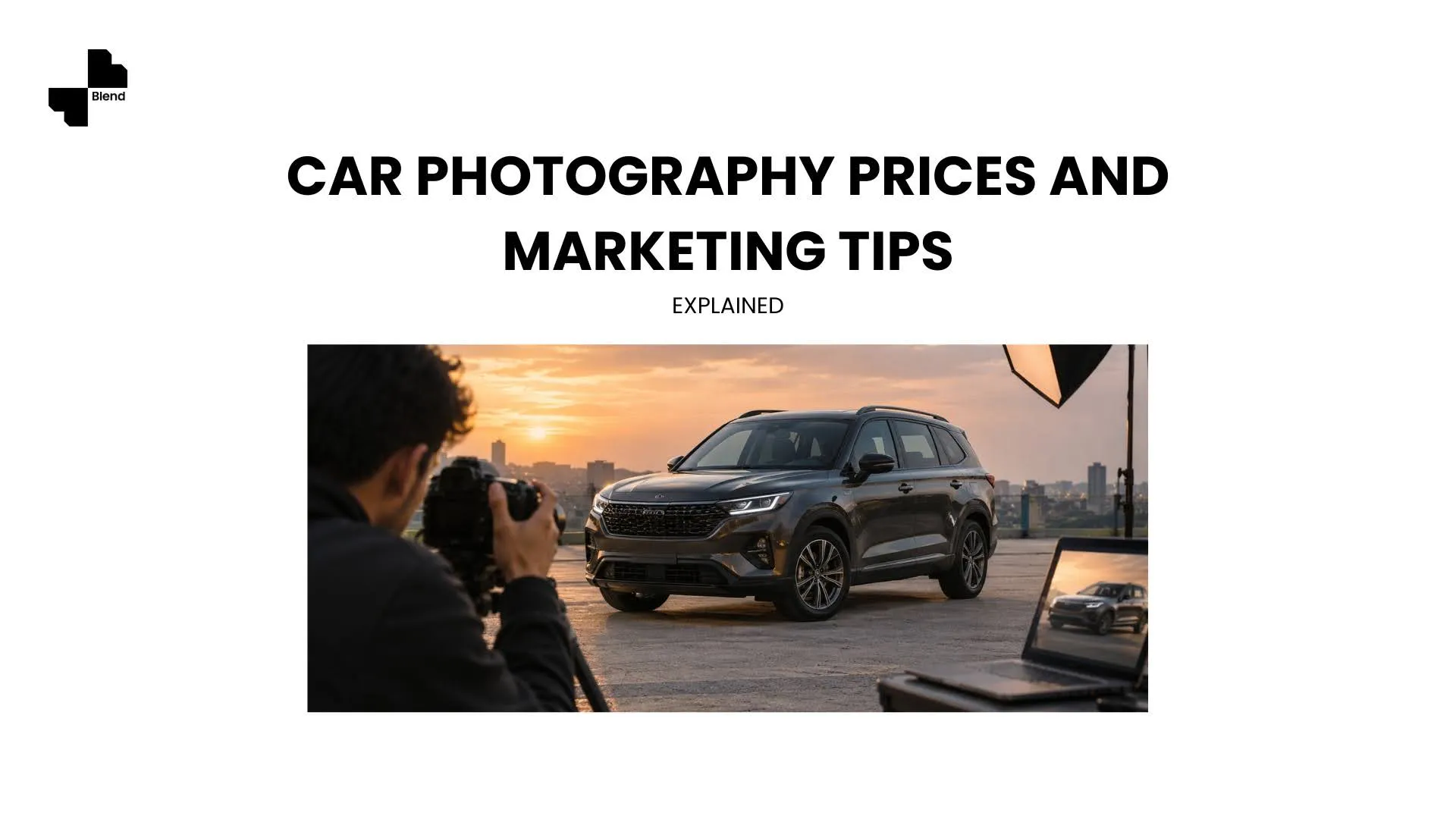
Professional car photography prices typically range from $200 to $500 per hour for an experienced photographer, with a full dealership shoot (location, editing, and delivery) often running $1,000 to $3,000+ depending on vehicle count and output needs. For dealerships managing large inventories, that cost repeats every time you add new stock, change seasons, or update your listings.
The pricing breakdown below covers what each level of photographer charges, why car photography is more expensive than standard product photography, and how AI tools eliminate the reshoot cycle entirely.
What Does Car Photography Actually Cost
A traditional car photography shoot (photographer, studio or location rental, editing) commonly runs from a few hundred to several thousand dollars depending on vehicle count and output needs. Blend removes the shoot entirely: upload your vehicle photos and use AI Photoshoot or Lifestyle Shot to generate showroom-quality or styled marketing images, cutting photo costs by 90% (as reported by Blend) with no studio booking required.
Here's what each photographer tier typically charges:
- Beginner photographer: $25-50/hour. Basic equipment, limited retouching. Suitable for a dealership testing online listings for the first time with minimal budget.
- Amateur/semi-pro photographer: $50-150/hour. Better equipment and some retouching included. A reasonable middle ground for smaller lots needing consistent quality.
- Professional car photographer: $200-500/hour. Studio-grade equipment, advanced post-production, multiple angles per vehicle. The standard for brand campaigns and premium listings.
- Full production shoot (studio + team): $1,000-3,000+ per session. Includes location, lighting rigs, stylist, and full editing. Necessary for brand-level campaign assets, excessive for day-to-day inventory listings.
Why Car Photography Costs More Than Standard Product Shoots
Cars are not small, portable products you can photograph on a table. Three factors drive up the cost consistently:
Reflections and Lighting Complexity
Body panels act as mirrors. Every surface reflects the environment around it, the lot, the sky, the photographer, nearby cars. Getting a clean reflection requires controlled lighting or extensive post-production, both of which add time and cost. Using Studio Shot to normalize the background and lighting after a basic phone capture eliminates the reflection problem at the editing stage rather than the shooting stage.
Location and Logistics
Moving vehicles to a photogenic location, blocking off shooting space, and coordinating around weather and daylight windows all add overhead that doesn't exist for products you can carry to a lightbox. AI background replacement means the vehicle never needs to leave the lot. Upload a photo taken where it sits and swap the background for a showroom, scenic road, or any other setting.
Volume and Consistency
A dealership turning over 50-200 vehicles per month needs photos for every single one. Hiring a photographer for each batch creates a recurring cost that scales linearly with inventory. AI tools break that cycle because one person with a phone can capture the vehicles, and batch processing normalizes the output across the entire inventory in minutes.
Marketing Tips for Dealership Photography
Once you have the images, the marketing strategy determines whether they drive leads or just fill a listing page.
Lead With Your Best Interior Shot
Exterior photos get the click. Interior photos close the deal. After the main exterior angle, make the second or third image an interior shot from the driver's seat. Shoppers deciding between two similar vehicles at similar prices will pick the one where they can see themselves sitting in it.
Match Images to Platform Expectations
AutoTrader and Cars.com want clean, well-lit hero shots. Your dealership website benefits from a mix of studio-style and lifestyle backgrounds. Social media ads perform best with short video walkarounds rather than static carousels. Format your images for each channel rather than using the same set everywhere.
Keep Your Inventory Visually Consistent
A listing page where every vehicle looks like it was shot by a different person on a different day undermines trust. Apply the same background treatment and lighting correction across your entire inventory so the page reads as a cohesive catalog, not a patchwork of phone photos. Use Magic Eraser to remove stray objects (cones, plates, signage) from individual shots without redoing the entire background.
Cut Your Car Photography Costs Without Cutting Quality
Upload your vehicle photos to Blend, apply a consistent background and lighting treatment, and export marketing-ready images for every platform your dealership uses. The 90% cost reduction comes from eliminating the photographer, the studio, and the reshoot cycle, not from lowering the output quality.
Frequently Asked Questions About Car Photography Prices
How much does professional car photography cost?
Professional car photographers charge $200-500 per hour. A full production shoot with location, lighting, and editing runs $1,000-3,000+ per session depending on vehicle count and deliverables.
How do dealerships market vehicle photos without a photoshoot?
Upload vehicle photos taken on the lot with a phone, then use AI tools like Blend to replace cluttered backgrounds with showroom or lifestyle scenes, normalize lighting, and export listing-ready images in batch.
Is AI car photography good enough for dealership listings?
For day-to-day inventory listings on AutoTrader, Cars.com, and dealership websites, AI-generated backgrounds and lighting correction produce professional results. Brand-level campaign shoots may still justify a dedicated production.
How many photos should a car listing have?
A competitive listing needs 15-20 photos minimum: 5 exterior angles, 5-6 interior shots, and close-ups of key features, wear points, and the odometer reading.
Can I use a phone for dealership photography?
Yes. Modern smartphone cameras produce sufficient resolution for online listings. The quality difference between phone and DSLR narrows significantly once you apply consistent backgrounds and lighting correction through AI tools.
How often should a dealership update listing photos?
Update photos whenever new inventory arrives. For vehicles that have been listed for 30+ days without engagement, refreshing the main image with a different background or angle can re-enter the listing into platform algorithms.