
Nano Banana vs Blend: Why Dedicated AI Software Matters
A visual, category-by-category comparison of Nano Banana and Blend across apparel, jewellery, and cosmetics—and why purpose-built AI software delivers consistency, accuracy, and trust at scale.
In today’s AI landscape, the number of tools available can feel overwhelming. From Nano Banana to Gemini, ChatGPT, Veo, and many others, the choices are endless. It’s natural to feel confused about which tool is actually right for you.
We don’t blame you for that confusion. Most AI tools are powerful in their own way, each designed with different strengths, assumptions, and priorities. Many of them perform exceptionally well in generic creative scenarios, especially when the goal is experimentation, ideation, or visual exploration.
However, when AI moves beyond experimentation and enters a business-critical workflow, the evaluation criteria change.
Breadth vs Depth (Without the Buzzwords)
Here’s the simplest way to look at it:
- General AI tools are built to handle many use cases.
- Dedicated AI software is built to handle one use case really well.
Tools like Nano Banana are great because they are flexible. You can try different styles, prompts, lighting ideas, and concepts quickly. Every generation is an experiment.
A tool like Blend is built with a specific goal in mind: visual commerce and catalogue production. It’s not trying to do everything. It’s trying to do one thing consistently.
That difference matters more than it sounds.
From Playing Around to Producing at Scale
Today, almost anyone can generate images or videos in seconds. That’s no longer the hard part.
The hard part is using those visuals at scale.
If you’re generating a few images, general AI works fine. You can review them manually, fix issues, and move on.
But when you’re generating hundreds or thousands of assets:
- Small inconsistencies add up
- quality varies between generations
- Results depend heavily on who is prompting
This is where general AI tools start to feel unpredictable.
Blend is designed to assume the output will be used repeatedly across teams, channels, and campaigns. That changes how the system behaves.
The Real Difference: Workflow, Not Just Images
Most AI conversations focus on outputs.
Real teams care about workflows.
With general AI tools:
- prompts live in documents or memory
- quality depends on the person using the tool
- Scaling means more manual effort
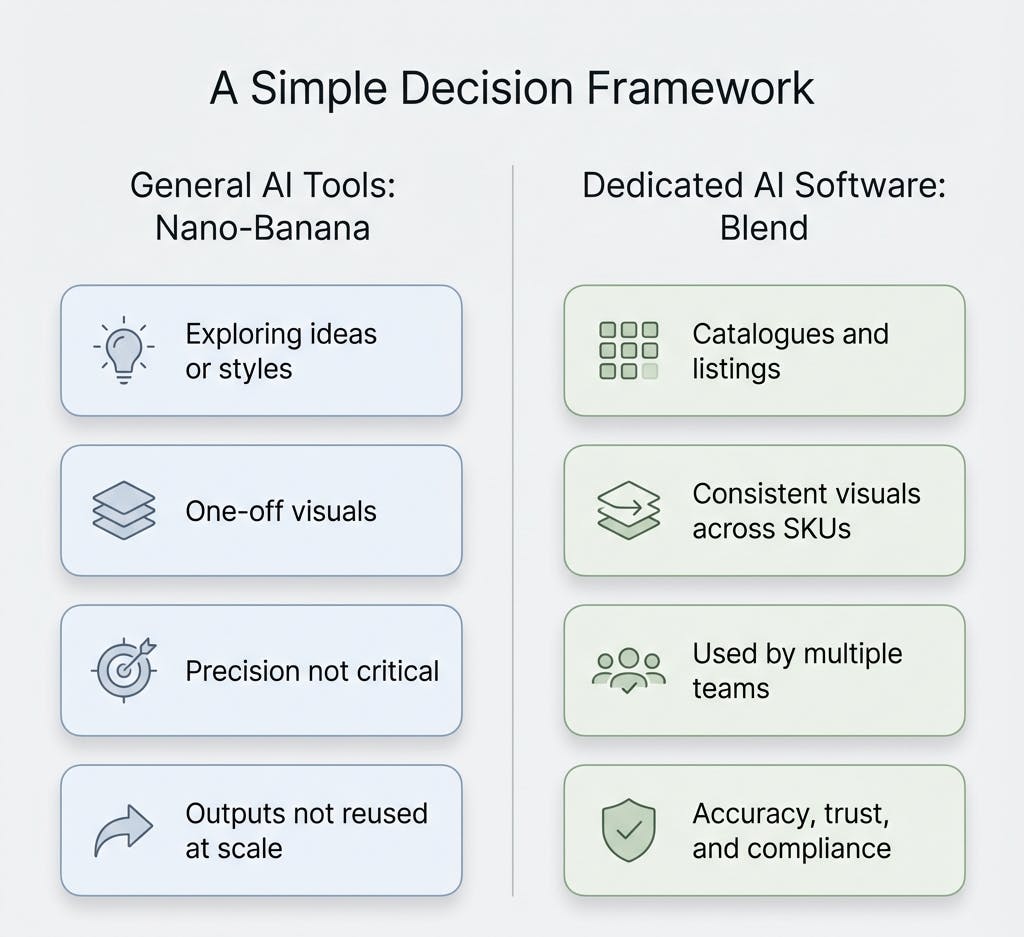
Blend treats catalogue creation like software, not guesswork:
- structured flows
- reusable setups
- consistent results
- usable by non-technical teams
So AI becomes part of the process, not just a creative shortcut.
Nano Banana vs Blend: A Fundamental Difference
Nano Banana is a versatile, general-purpose creative system that brings together a wide range of capabilities under one umbrella. Its real strength lies in its open, prompt-driven design, which enables rapid experimentation with very few constraints.
Each generation functions as an exploratory step, making the overall experience especially effective for creative discovery.
In contrast, Blend can be viewed as a specialised subset of general AI. It is a purpose-built platform designed specifically for brands, with a strong focus on improving cataloguing and marketing, particularly within apparel and lifestyle categories.
Blend’s value proposition is not centred on randomness or novelty; instead, its strength lies in structured workflows, controlled outputs, and the ability to deliver repeatable, consistent results at scale.
As a result, for use cases that require generating hundreds of thousands of images, Nano Banana would not be the optimal choice. In contrast, Blend is well-suited for that level of high-volume, standardised production.
Where the Differences Start to Matter
If this is starting to sound overly technical or jargon-heavy, don’t worry, we’ll keep things simple. We’ll do this by walking through specific categories where expectations and requirements change significantly.
The four categories we’ll focus on are:
- Apparel
- Jewellery
- Cosmetics
- Fashion Accessories
For each category, we’ll show how a general-purpose AI and a dedicated AI like Blend behave differently, and why Blend is the better choice for brands when it comes to creating catalogues using AI.
The goal is to demonstrate how AI can take on the heavy lifting while helping you reduce costs compared to traditional photoshoots and other conventional methods.
1) Apparel
If you’ve read our previous blogs, and if you haven’t, we recommend checking them out at How to Use AI Models for Clothing.
You may already be aware that apparel relies heavily on fit, posture, and how the fabric behaves on the human body.
What AI needs to do, therefore, is preserve the garment’s structure and silhouette, maintain a consistent fit across different poses, and respect fabric drape, folds, and tension. It must also keep body proportions stable while allowing pose variations without altering the product itself. In apparel, if the fit changes, the product changes.
Now, let's see a visual demo of this drawing and an effective comparison with Blend and Nano-Banana.
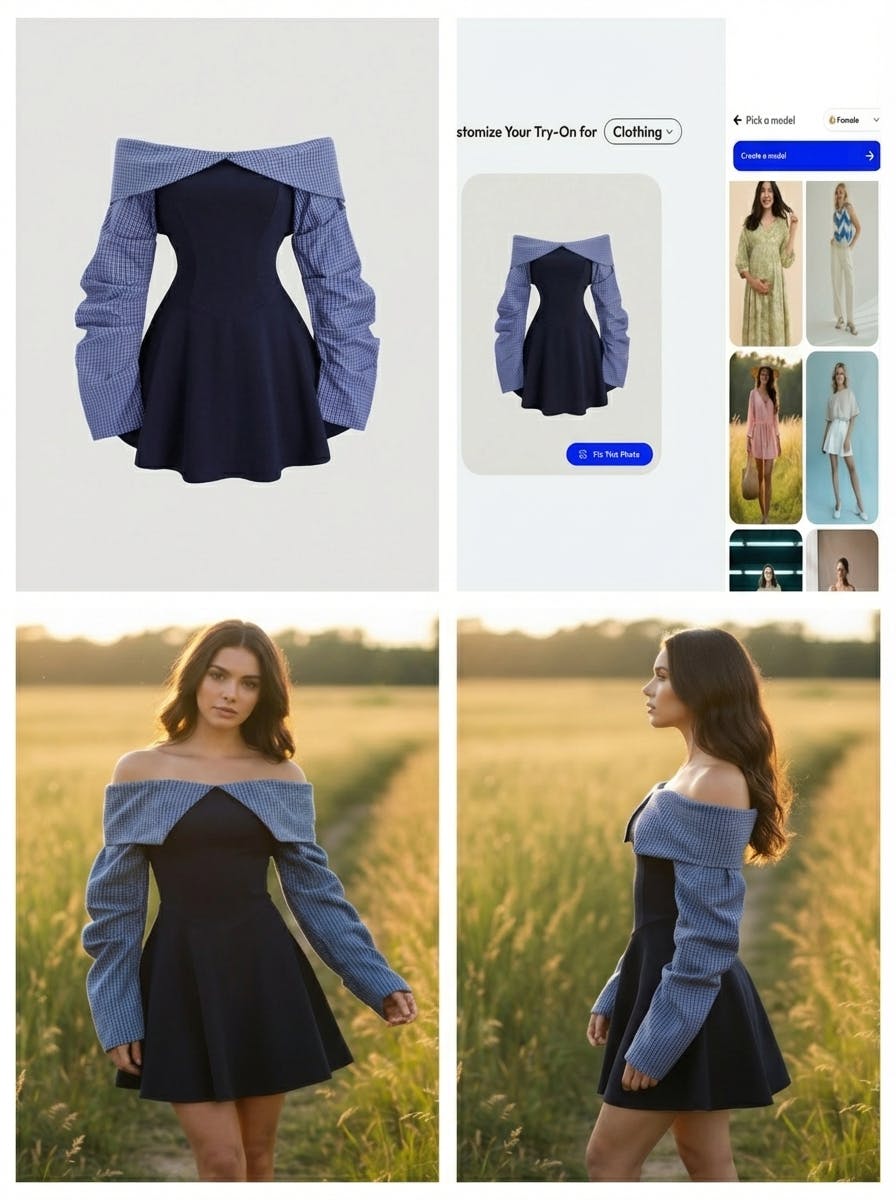
We would be using the AI Model feature in the Blend app. Firstly, we selected the input image and uploaded it. As you can see, the Blend web app offers several preset models and the option to create a custom model. We selected one of the presets, and the third image shown reflects the generated output.
We then changed the model’s pose, and the updated result is displayed directly within the interface, clearly demonstrating the desired outcome.
Now, using the same input image, let’s try Nano Banana with a very simplified prompt and see what it produces in the very first iteration.
The Prompt: " A realistic full-body photo of a female model wearing the dress from the reference image. Natural posture, minimal lifestyle setting, soft natural lighting. The dress should look realistic and wearable, photographed in a casual outdoor environment. "
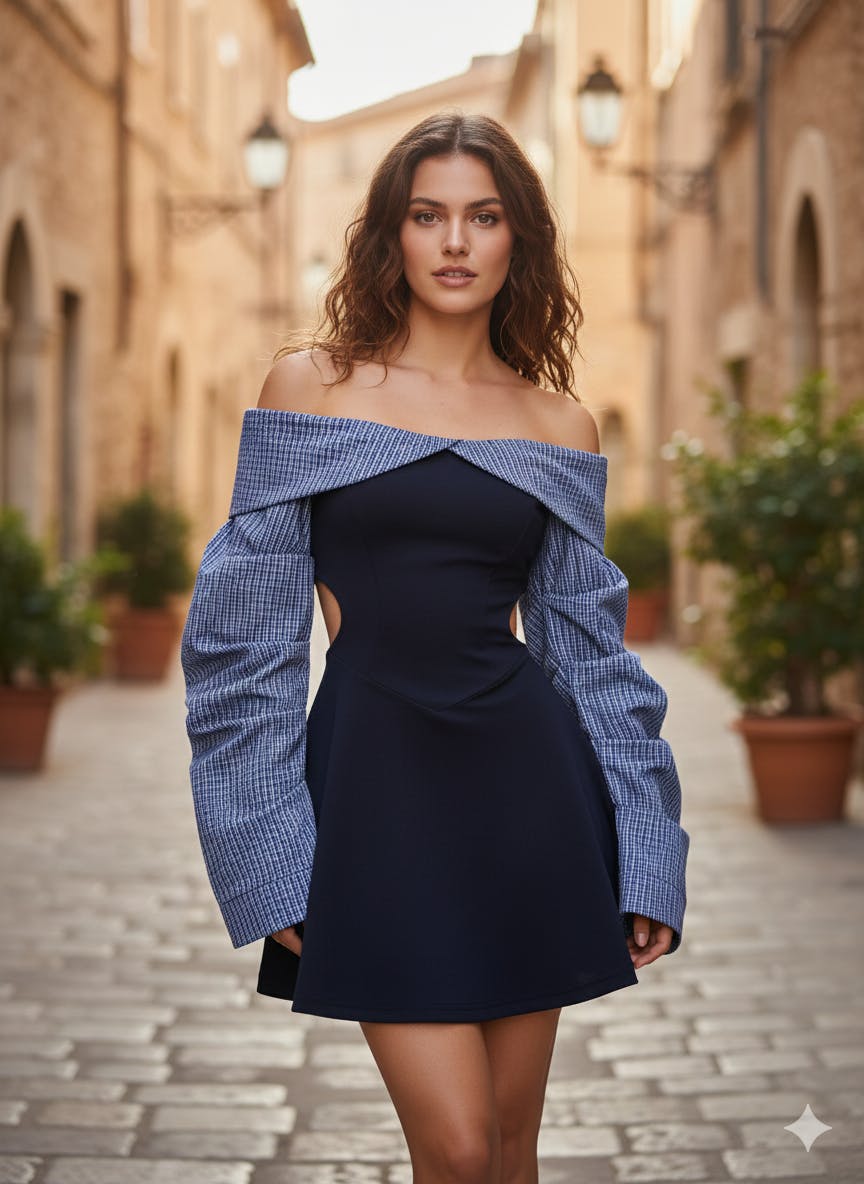
In the Nano Banana output, the dress is visually recognisable but structurally reinterpreted.
Fit, sleeve volume, and construction details adapt to the model and the scene.
This approach works well for creative visuals, but it introduces variation that makes catalogue-level consistency difficult.
In contrast, Blend treats the dress as a fixed product input. Pose and environment change, but garment construction remains stable, making the output suitable for repeatable production workflows.
2) Jewellery
In contrast, jewellery is an object-first category, where scale, material fidelity, and precision matter far more than human pose. The AI must preserve exact scale and proportions, maintain sharp edges and fine material details, and carefully control reflections and light interaction.
The jewellery should remain the clear visual hero, with any human context used only as supporting context rather than the focal point. In jewellery, interpretation reduces trust.
We now repeat the same process for the jewellery category, this time using a Lifestyle Shot on Blend.
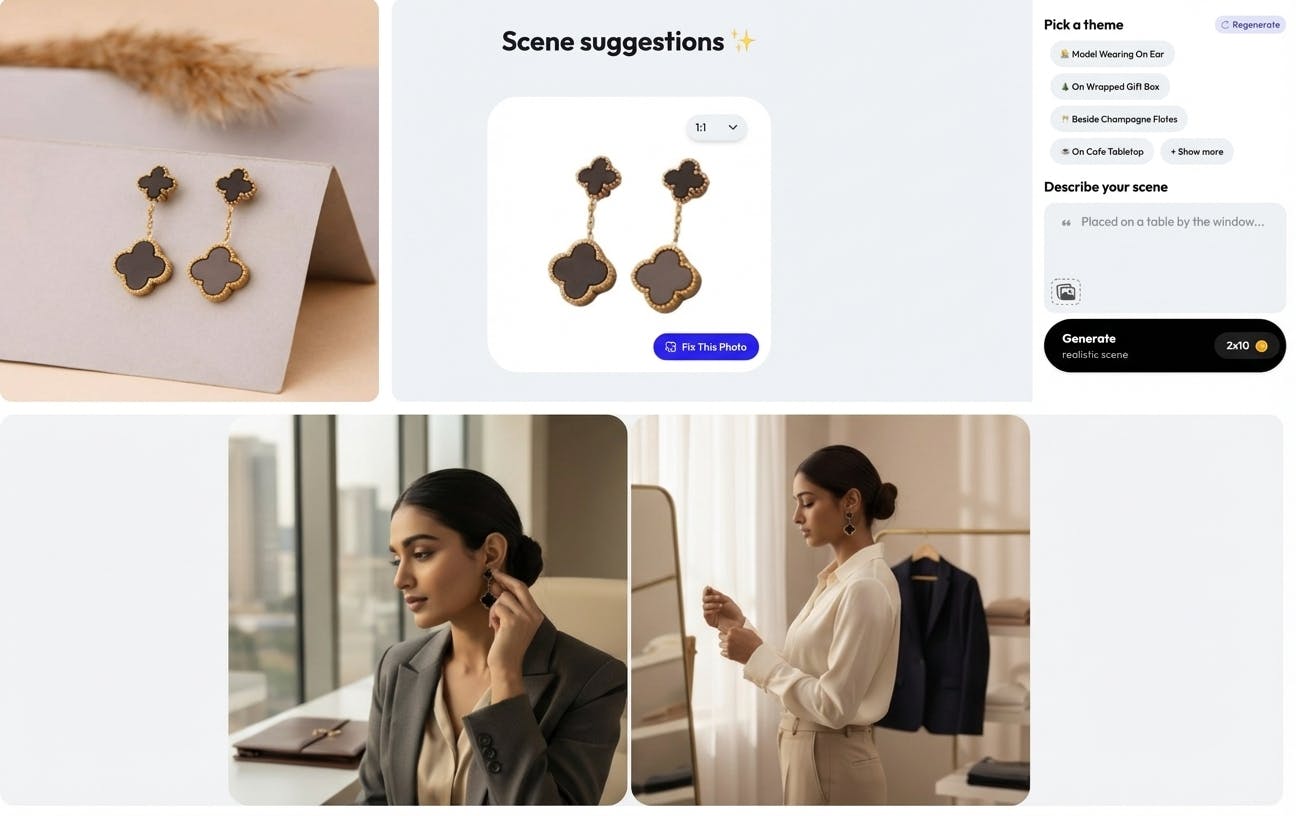
After uploading the input image, as shown in the graphic, the Blend web app analyses it and automatically provides templatized presets. From there, you can see the system's final outputs.
We then used the exact same input image with Nano Banana, without any cropping, masking, or enhancements, and applied a very simplified prompt to observe the results under identical starting conditions.
The Prompt: "A realistic lifestyle photo of a woman wearing the earrings from the reference image. Clean, minimal indoor setting, soft natural lighting. The jewellery should look elegant and wearable."
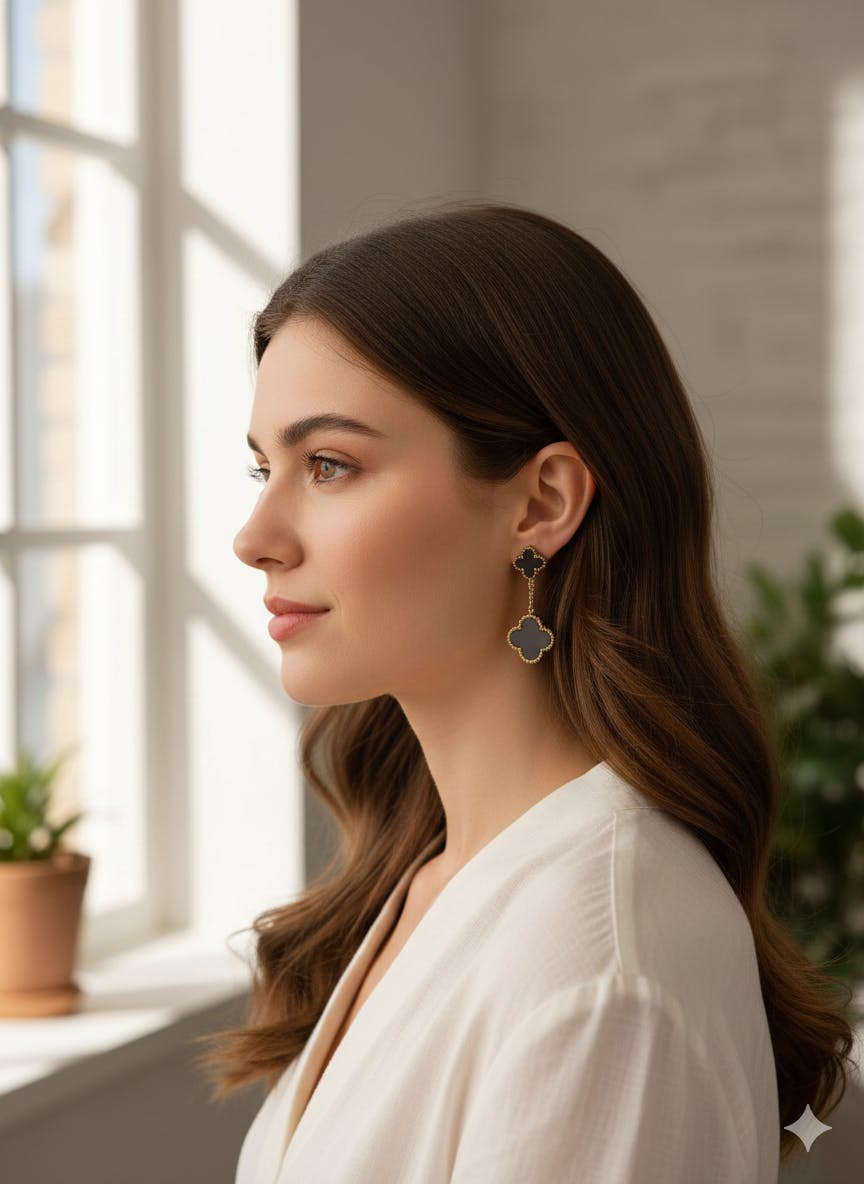
Do you notice the difference:
While Nano-Banana can generate visually appealing lifestyle imagery, subtle shifts in scale, surface detail, and light interaction make it difficult to extend these outputs into motion safely. With jewellery, realism is not enough; precision matters. For dedicated jewellery workflows, on the other hand, Blend prioritises object fidelity, allowing lifestyle images to scale into video without risking loss of jewellery context.
3) Cosmetics
Cosmetics are fundamentally driven by trust, skin realism, product clarity, and believable usage are critical.
What AI needs to do is maintain natural skin texture without over-smoothing, preserve label clarity and accuracy, and depict product usage in a physically believable way. It must avoid exaggerated glow or artificial perfection while ensuring visuals remain compliant and safe for marketplaces.
We now apply a similar workflow to cosmetics using the lifestyle shot at Blend.
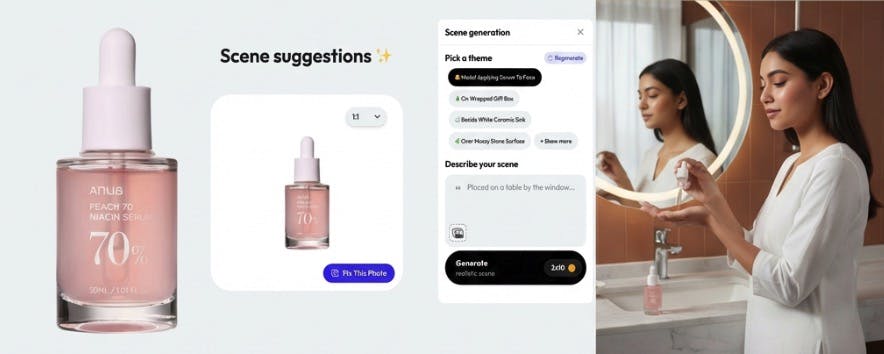
Once the image is uploaded, the Blend web app analyses it and offers presets suited for cosmetics. These presets focus on skin realism, precise product details, and realistic usage, which is reflected in the final outputs.
In parallel, we used the same input image with Nano Banana, without any cropping, masking, or manual enhancements, and prompted it in a minimal, simplified manner to compare the first-pass results.
The Prompt: " A realistic lifestyle photo of a woman applying a skincare serum from the reference image to her face.Clean bathroom or vanity setting, soft, natural lighting. The scene should look natural and realistic. "
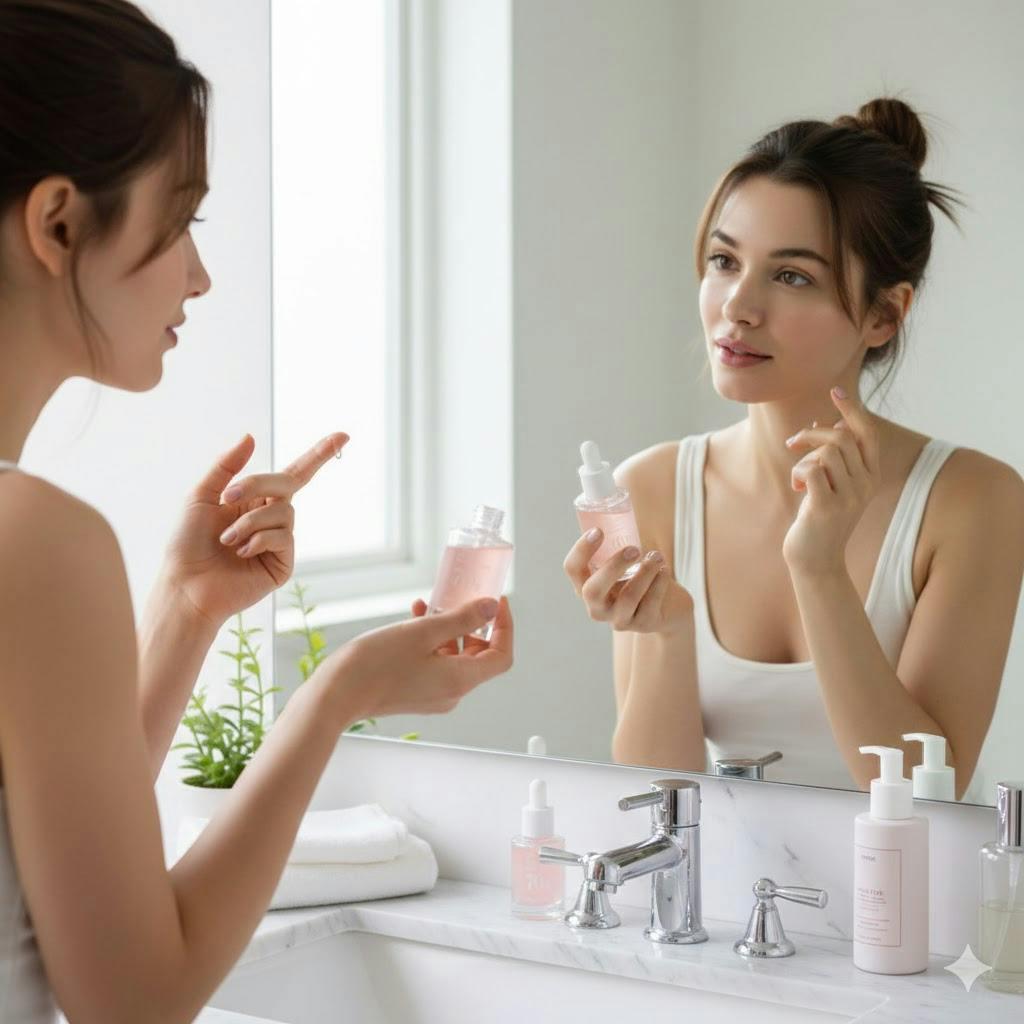
In this Nano Banana output, the scene feels polished and aspirational, but product fidelity degrades in subtle ways; label clarity, object consistency, liquid behaviour, and skin realism are optimised for visual appeal rather than commercial accuracy.
4) Fashion Accessories
Fashion accessories are a broad and diverse category, ranging from sunglasses to handbags. Accessories sit at the intersection of fashion and product, where scale and visual hierarchy can easily be lost.
What AI must do is preserve the correct product scale relative to the body, maintain material finishes and hardware details, and ensure realistic grip, weight, and carry behaviour. The accessory should remain the primary focus, with the environment supporting the product rather than overpowering it. In accessories, scale and structure drive perception.
We then follow the same workflow for the fashion accessories category, using a lifestyle image as the input.
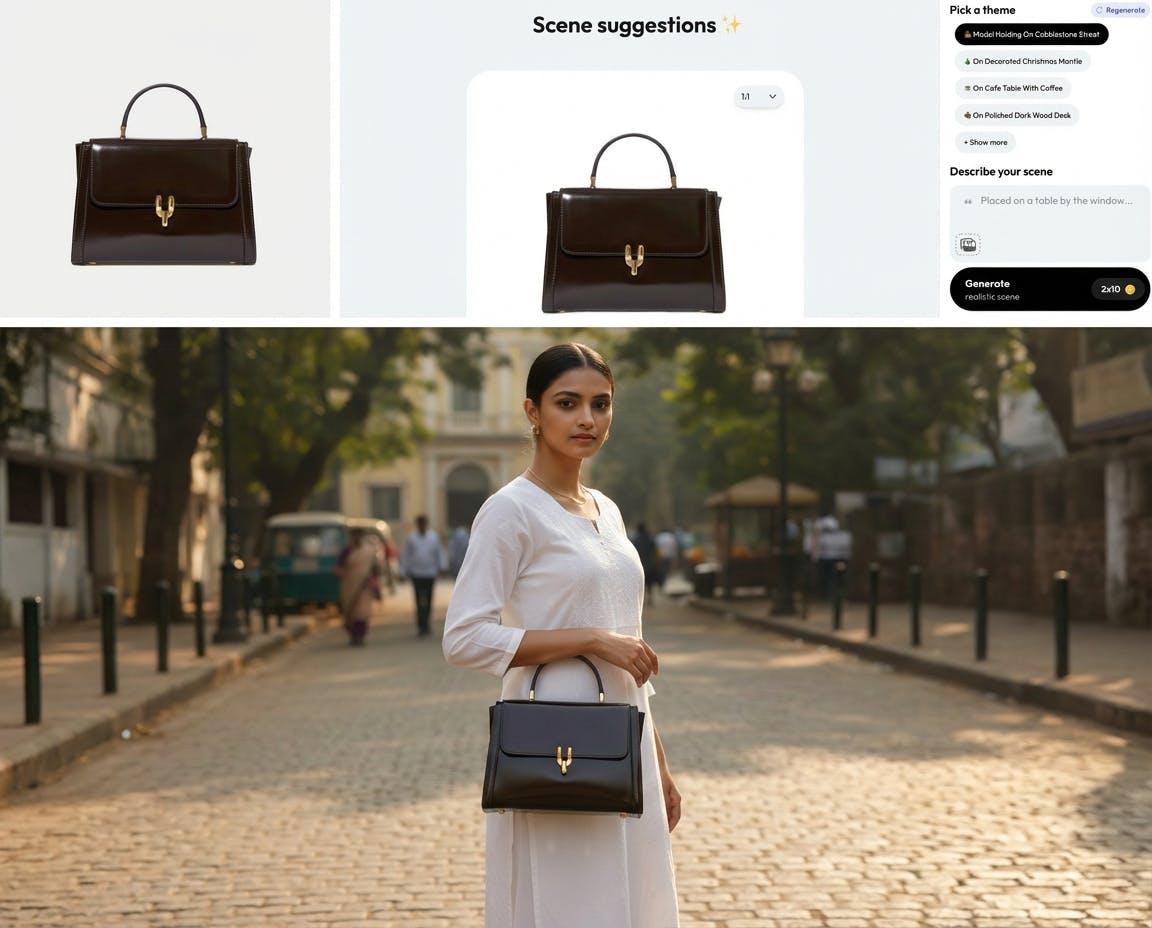
After uploading the image, the Blend web app analyses it. It presents preset configurations suited to accessories, taking into account scale, material finish, and how the product is carried or worn. The resulting outputs demonstrate how these factors are preserved.
In comparison, we used the same lifestyle image with Nano Banana, without any cropping, masking, or enhancements, and applied a simplified prompt to observe the initial output under the same conditions.
The Prompt: "A realistic lifestyle photo of a woman applying a skincare serum from the reference image to her face.Clean bathroom or vanity setting, soft natural lighting. The scene should look natural and realistic."

In the Nano Banana output, the handbag integrates naturally into the lifestyle scene, but scale, material presence, and product hierarchy subtly shift to serve the overall image. The bag becomes a styling element rather than a fixed product reference.
The Pattern Across Categories
Across all four categories, the requirement is consistent: AI should not reinterpret the product. It should respect it. Nano Banana, as a general-purpose AI, is built to optimise for visual appeal. It fills in gaps, smooths inconsistencies, and adapts products to fit the scene. This works well for creative exploration, but it introduces risk when the product itself must remain exact.
Blend approaches the problem from the opposite direction. It treats construction, scale, material behaviour, and proportions as fixed constraints, allowing only the surrounding context to change. As the stakes increase, such as fit in apparel, precision in jewellery, and trust in cosmetics, the pattern becomes clear. Creativity is not the bottleneck. Precision is. That is why Blend matters, not because it is more expressive, but because it understands what must not change.
Conclusion
As AI tools become more accessible, the core challenge shifts from creating visuals to trusting them. Across apparel, jewellery, cosmetics, and accessories, a clear pattern emerges: when visuals represent real products, accuracy matters far more than novelty.
If your AI workflows feel unstable, inconsistent, or require too much manual effort, it’s often a sign that you’ve outgrown the experimentation phase. Blend is built for teams that need AI to function as production infrastructure, dependable, repeatable, and aligned with the practical demands of visual commerce.