
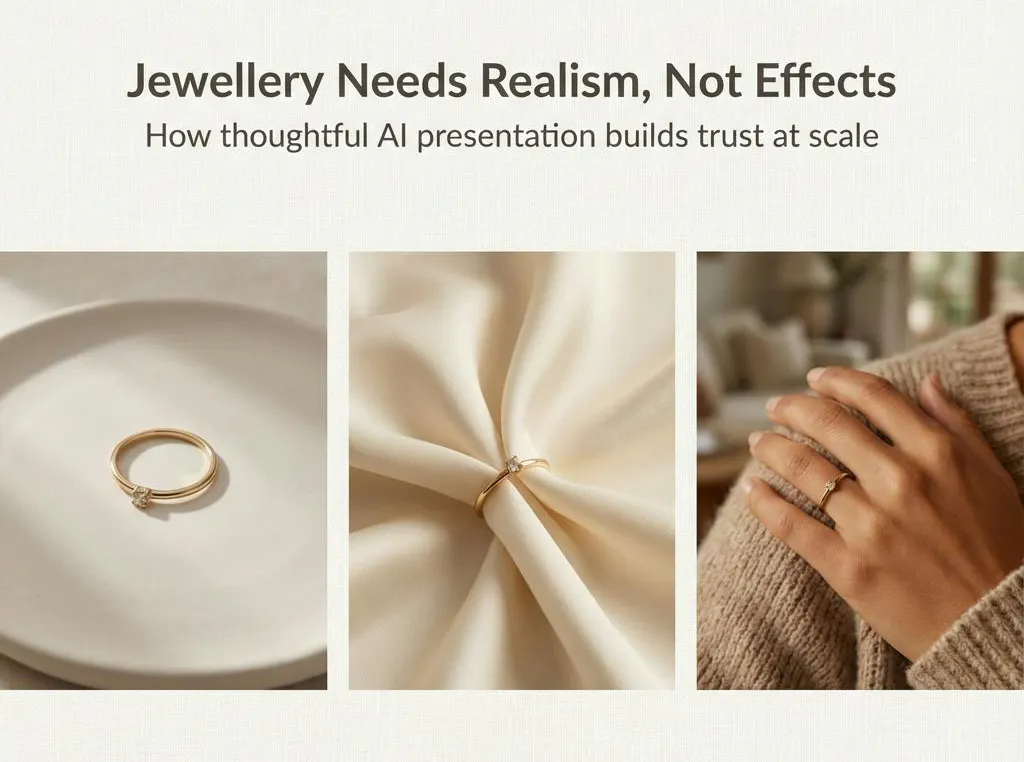
Hola
If you have been following this series, kudos to you. You are actively investing time in improving how your brand appears visually, which already puts you ahead of the curve.
If you are still wondering how AI fits into traditional photoshoots or whether it can replace or complement seasonal cataloging, this is a good time to revisit our earlier blogs. We have already covered how AI supports Seasonal Catalog creation and why visuals play such a critical role in driving conversions.
So far, our focus has been primarily on apparel. We explored how AI helps with clothing catalogs, how it simplifies seasonal refreshes, and how to use AI Models correctly for apparel visuals. But as brands grow, they rarely remain confined to a single category. The moment you move beyond clothing and start experimenting with other product lines, one thing becomes clear very quickly: not all categories behave the same way in AI workflows.
That brings us to today’s focus: jewellery.
Jewellery is one of the most widely listed product categories in e-commerce. At the same time, customer expectations around jewellery visuals have evolved significantly. Buyers are more detail-oriented, more skeptical, and far more conscious of how a piece looks, even when shopping online.
In this piece, we break down how AI works for jewellery, where it adds value, where it does not, and how to create visuals that feel premium, realistic, and trustworthy.
Why Jewellery Needs a Different AI Approach
Here is the key difference: jewellery does not behave like clothing.
With apparel, AI primarily solves for fit, drape, posture, and body compatibility. The human model plays a central role in how the product is perceived. Jewellery, on the other hand, is an object-first category.
AI is not trying to understand movement or posture here. Instead, it focuses on material properties, light interaction, scale, proportions, and micro-details.
A ring does not need a pose. A necklace does not need posture. What jewellery needs is absolute realism.
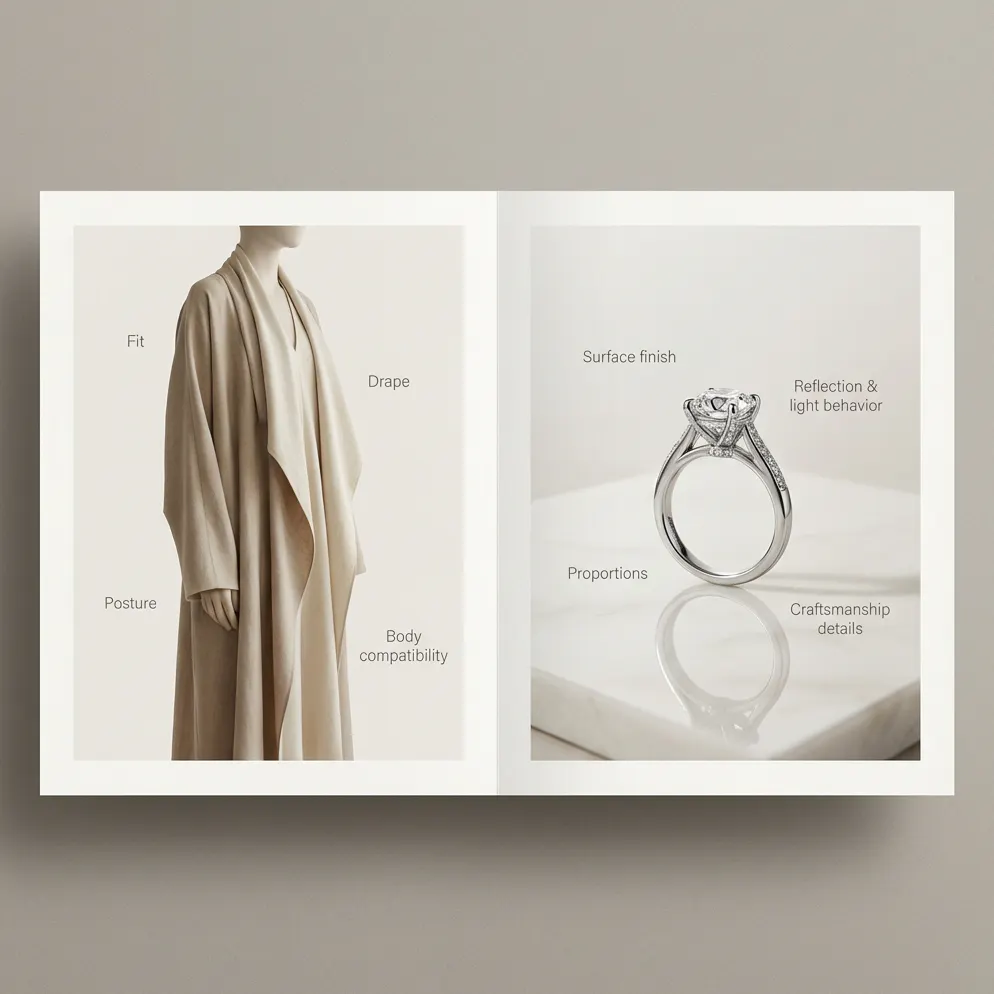
This is why jewellery visuals succeed or fail based on:
- Surface finish
- Reflection and light behavior
- Proportions
- Fine craftsmanship details
This is an essential shift in mindset, because jewellery relies far more on input quality and material accuracy than on model choice.
This difference alone is why jewellery deserves its own AI workflow and why applying apparel logic directly to jewellery often leads to poor results.
Now the question arises, what to do and the right way to do it when it comes to using AI for jewellery.
What To Do: Preparing Jewellery Images for AI
Follow these practical guidelines to ensure your jewellery images are AI-ready and produce consistent, high-quality results.
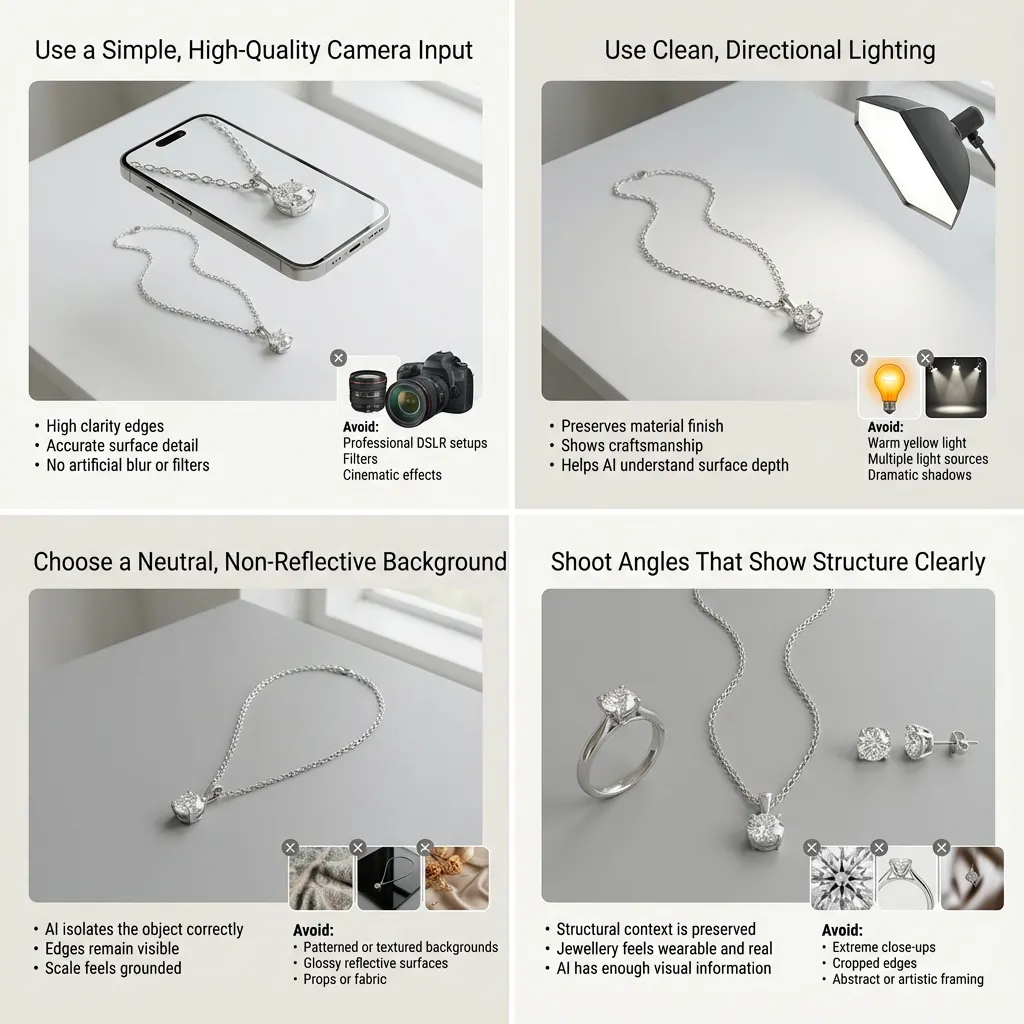
1. Use the Right Camera (You Do Not Need a DSLR)
You do not need professional gear.
What works:
- A modern smartphone (iPhone / Pixel/flagship Android)
- Clean lens
- Shoot in default camera mode (no beauty filters, no HDR exaggeration)
Avoid:
- WhatsApp-downloaded images
- Screenshots
- Marketplace images with compression
2. Lighting: Keep It Simple and Honest
Jewellery fails in AI when lighting hides detail.
Recommended setup:
- One white light source (window light or soft LED)
- Light positioned at a 45° angle from the jewellery
- Avoid direct top-down harsh light
Why this matters:
- Shows surface texture
- Prevents blown-out highlights
- Preserves edge clarity for AI interpretation
Avoid:
- Yellow ambient light
- Mixed lighting (white + warm)
- Dramatic shadows
3. Background: Neutral Always Wins
Use:
- White sheet
- Matte grey surface
- Clean the table near a window
Avoid:
- Patterned backgrounds
- Fabric textures
- Glossy surfaces that reflect off the metal
Jewellery AI performs best when it can clearly isolate the object.
4. Angle: Show Structure, Not Drama
Correct angles:
- Rings: slight tilt (not flat, not vertical)
- Necklaces: lay naturally, no forced curves
- Earrings: straight-on, matching orientation
Shoot:
- One primary angle
- One secondary angle (optional)
Avoid:
- Extreme close-ups
- Artistic angles
- Cropped edges
AI needs context, not abstraction.
When these fundamentals are followed, AI can accurately interpret jewellery and generate visuals that remain true to the product.
What Not To Do (And Why These Fail)
The following mistakes often undermine AI jewellery outputs and should be avoided.
1. Over-Stylized Lighting
Why it fails:
- Hides true metal finish
- Exaggerates reflections
- Causes AI to hallucinate surfaces
Result:
- Jewellery looks fake or plastic-like
2. Ignoring Scale
Why it fails:
- AI cannot infer size without reference
- Rings look toy-sized or oversized
- Earrings lose their wearability context
Result:
- Buyer distrust
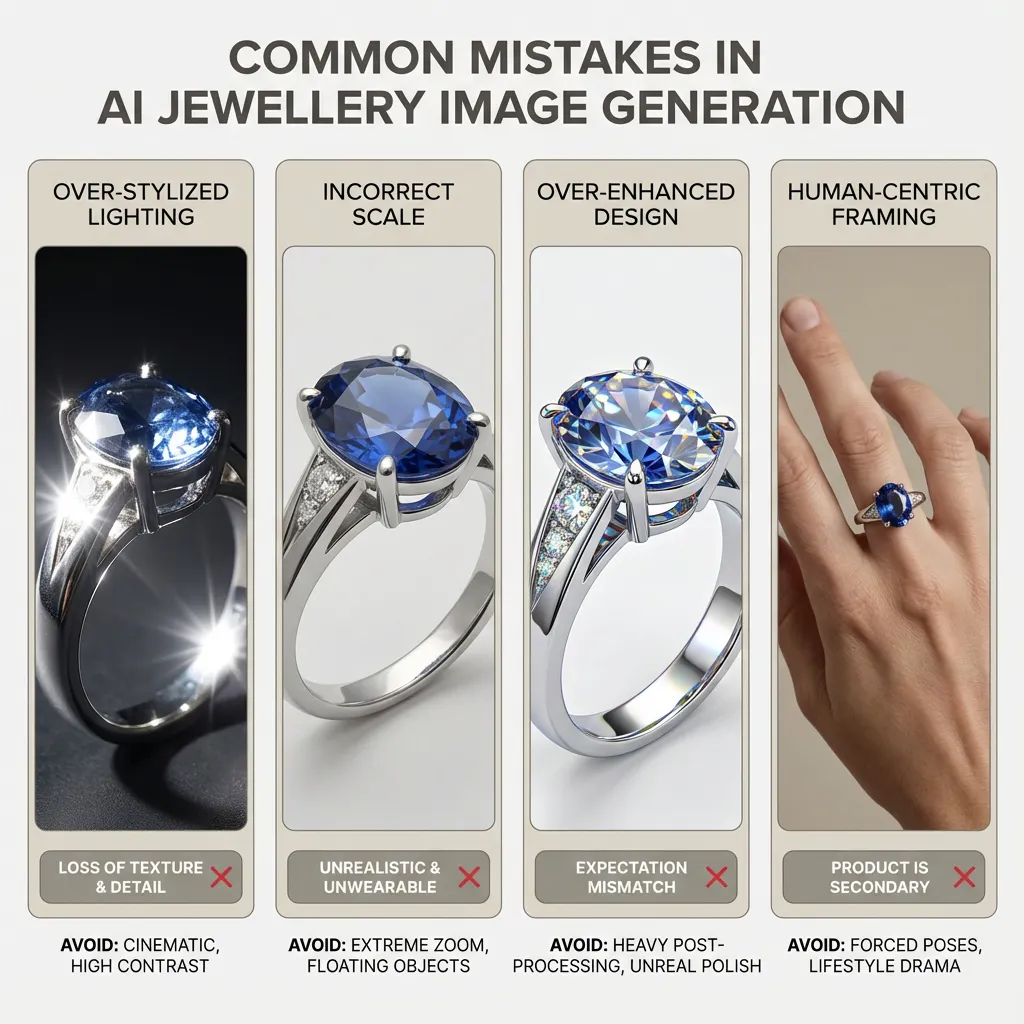
3. Enhancing Designs Beyond Reality
Why it fails:
- AI “polishes” edges unrealistically
- Stones appear larger or sharper
- The product delivered does not match the visual
Result:
- Higher returns
- Lower repeat trust
4. Treating Jewellery Like Apparel
Why it fails:
- Human-centric prompts add unnecessary anatomy
- Distracts from the product
- Introduces pose inconsistency
Result:
- Visual noise instead of clarity
This aligns closely with the most common mistake jewellery sellers make on marketplaces like Etsy, where over-editing and poor presentation directly impact buyer trust and conversions.
How AI Actually Adds Value for Jewellery
AI is strongest when used for:
- Clean lifestyle context (not drama)
- Consistent catalog presentation
- Faster seasonal refreshes
- Marketplace-ready visuals
- Ad creatives that feel realistic
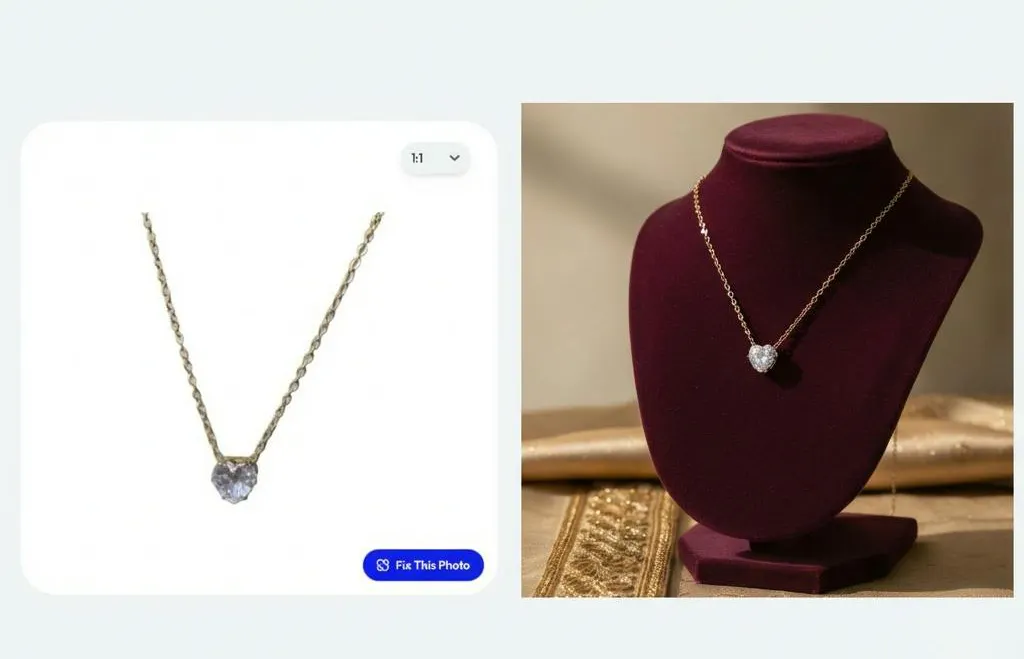
Using Blend’s Lifestyle Shot feature, you can create these environments at scale while maintaining realism and visual discipline.
AI does not replace:
- Macro shots for certifications
- Hallmark visibility
- Stone grading visuals
This is a complementary workflow, not a replacement.
How This Fits into a Larger Branding Strategy
If you have read our earlier blogs, the pattern should be clear.
AI is not just cheaper than traditional photoshoots. It is also more scalable when used correctly. But each category needs its own visual logic.
Clothing, jewellery, and footwear all benefit from AI, but in different ways. When used thoughtfully, AI allows brands to maintain visual consistency across categories, scale catalog production without scaling costs, and adapt visuals for marketplaces, ads, and seasonal campaigns.
Jewellery is simply the next layer in this system.
Conclusion
AI does not replace craftsmanship. It reflects it. For jewellery, the real moat is not visual effects but confidence built through realism.
When visuals feel honest, detailed, and intentional, buyers trust the product.
At Blend, we design these workflows so brands do not have to overthink or overengineer the process. The focus stays exactly where it should be: showcasing your jewellery in the best possible light, consistently and at scale.
If you are ready to explore this for your own catalog, head over to Blend and try it out yourself.